Replacing Traditional Inkjet Printing with UV Laser Marking
In plastic pipe manufacturing, product information, brand logos, specifications, and identification details must be clearly marked as pipes move along the production line.
For manufacturers looking to replace traditional inkjet printing with laser marking, the transition involves more than achieving clear marking results. Material compatibility, marking quality, production line integration, installation conditions, and operating requirements all play important roles in selecting the right equipment.
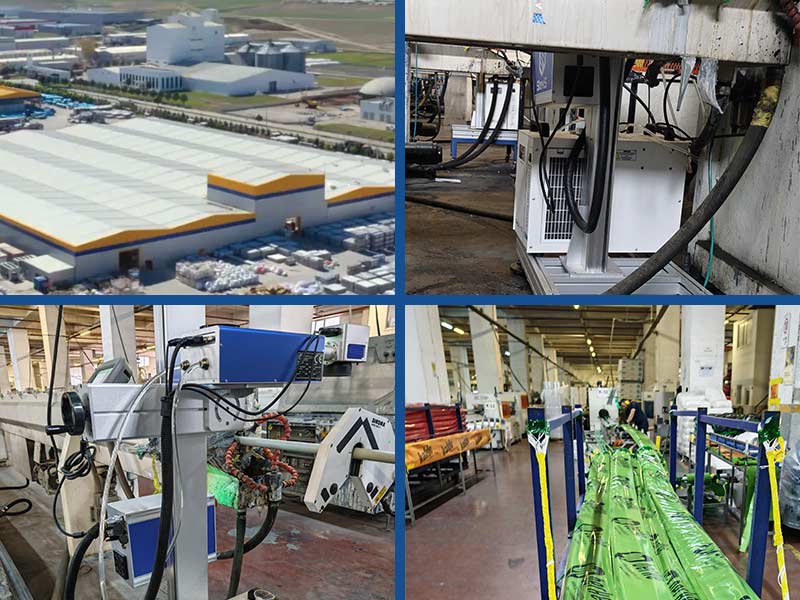
A Turkish plastic pipe manufacturer approached SteviS through our official website to explore UV laser marking as an alternative to its existing inkjet printing process.
Following initial technical discussions, sample testing, and equipment configuration, the customer placed an initial order for 15 units of 10W UV flying laser marking machines, together with two additional laser marking machines.
After receiving and putting the first air-shipped machines into operation, the customer continued the cooperation and placed a second order in September 2026 for another 21 units of ST-LMU 10W UV flying laser marking machines.
The two orders bring the customer's total purchase to 36 sets of UV flying laser marking machines from SteviS.
1. Testing UV Laser Marking on Different Pipe Materials and Colors
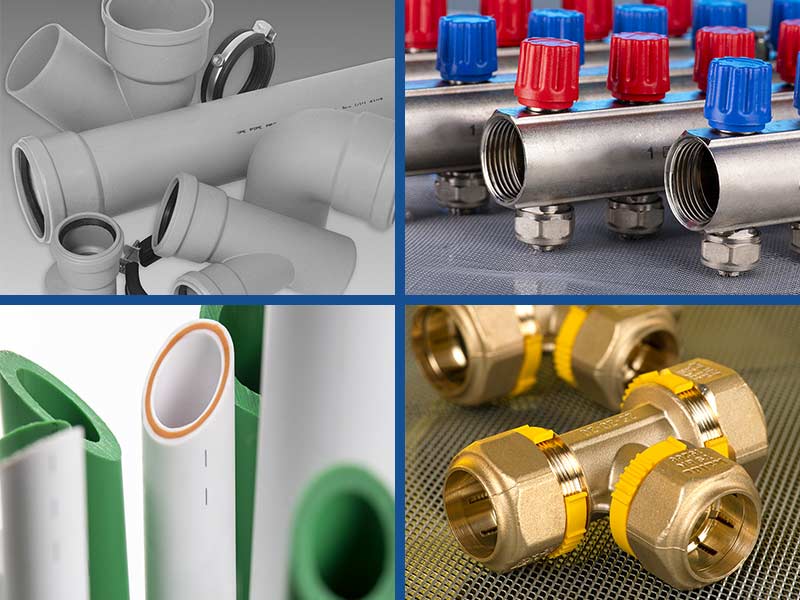
The customer's main applications involve plastic pipes, particularly PPR and PVC pipes in different colors.
Before finalizing the equipment configuration, several technical factors needed to be evaluated:
Material compatibility: Assessing UV laser marking performance on different plastic pipe materials.
Marking clarity: Ensuring that text, product specifications, and brand logos remain clearly visible across different pipe colors.
Laser power selection: Evaluating the suitability of 10W UV laser marking for the customer's actual applications.
Flying marking requirements: Considering how the laser marking system would operate while pipes continuously move along the production line.
To better understand the customer's requirements, the SteviS team reviewed existing inkjet production line videos, pipe information, and marking samples.
Based on these details, marking tests were conducted on pipes in multiple colors to help evaluate the marking results and determine a suitable equipment configuration.
This application-focused approach allowed both teams to move beyond theoretical specifications and make equipment decisions based on actual production materials and marking requirements.
2. Customizing Equipment for Existing Production Line Integration
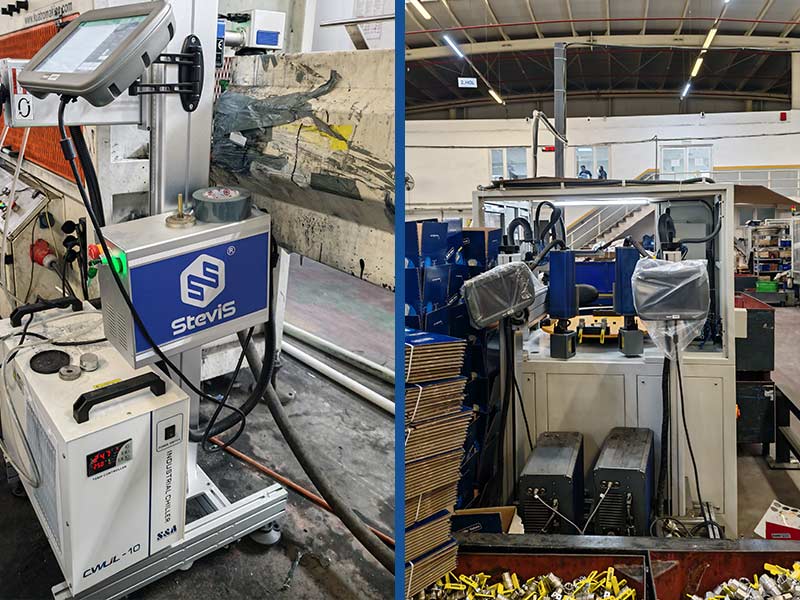
Once the equipment direction was established, the next step was to address the practical requirements for integrating the UV flying laser marking machines into the customer's existing production environment.
SteviS worked closely with the customer to confirm several installation and operating details, including:
Stand and marking-head height: Confirming the required mounting structure and working height to suit the existing production line.
Operating interface: Discussing the interface requirements for convenient daily operation.
Font and marking content: Confirming font support for product specifications, text, and logos.
Machine identification: Coordinating equipment identification and labeling requirements.
Export packaging: Preparing suitable packaging for international transportation.
In addition, SteviS coordinated the required CE-related documentation, declarations of conformity, and bilingual English–Turkish safety warning labels.
The initial order was arranged through separate air and sea shipments according to the customer's delivery requirements. Four machines were shipped by air first and have since been put into use.
By addressing installation conditions, operating details, and export requirements before delivery, SteviS helped make the equipment procurement process more closely aligned with the customer's actual production needs.
3. A Repeat Order of 21 Machines Following Initial Cooperation
After the initial equipment was delivered and put into use, the customer decided to expand the cooperation with SteviS.
Following further discussions regarding equipment configuration, order quantity, and commercial terms, the customer confirmed a second order in September 2026 for 21 additional ST-LMU 10W UV flying laser marking machines.
The project now represents a total purchase of 36 UV flying laser marking machines across two orders.
This repeat order reflects the customer's continued confidence in the SteviS equipment and the technical coordination provided throughout the purchasing and delivery process.
From the initial evaluation of inkjet printing alternatives to equipment testing, production line adaptation, and subsequent procurement, the project demonstrates the importance of understanding the customer's complete manufacturing process when introducing a new marking solution.
4. SteviS: More Than Equipment Supply
At SteviS, we believe successful equipment selection starts with understanding the customer's actual production requirements.
For manufacturers considering a transition from inkjet printing to UV flying laser marking, our team can help evaluate:
Pipe materials, including PPR, PVC, and other plastic materials.
Pipe colors and required marking contrast.
Marking content, including logos, text, and product specifications.
Production line speed and flying marking requirements.
Equipment installation space and mounting conditions.
Equipment configuration and delivery requirements.
Rather than simply recommending a machine based on its specifications, SteviS focuses on developing practical equipment solutions that fit each customer's production environment.
Looking to Replace Inkjet Printing with UV Laser Marking?
Whether you manufacture PPR pipes, PVC pipes, or other plastic products, SteviS can help you evaluate a suitable UV laser marking solution based on your materials, marking requirements, and production line conditions.
Contact the SteviS team to discuss your application and explore the possibilities of upgrading your marking process.
In the highly competitive steel processing industry, high efficiency, precision, and stability have become the core criteria for clients when selecting equipment suppliers.
Recently, a well-known Indian steel manufacturing enterprise presented us with specific pipe cutting requirements:
Max. Pipe Diameter: 120 mm
Max. Wall Thickness: 4.5 mm
Material: MS (Mild Steel)
Raw Material Length: 6 m
Finished Cut Length: Up to 2.5 m
Automatic Loading Rack Capacity: 2.5–3 tons
With twenty years of experience in steel manufacturing and processing, this client maintains extremely high standards for equipment reliability, safety, and productivity.
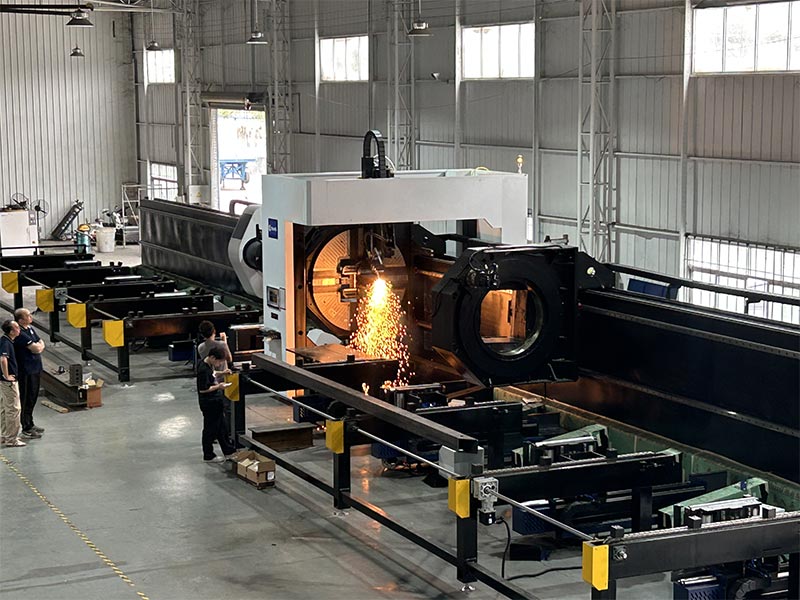
Following in-depth communication and technical evaluation, we customized a Dual Chuck Laser Pipe Cutting Machine solution, optimizing both mechanical structure and control systems to meet their specific production needs.
The collaboration was confirmed shortly after proposal delivery and finally placed an order for two laser tube cutting machines.
Customization Highlights
Dual Chuck Design:Minimizes vibration and deviation during long pipe cutting, ensuring perpendicularity and dimensional accuracy.
Reinforced Material Storage & Load-Bearing Structure:Engineered with upgraded materials and structural design to handle 2.5–3 ton pipe bundles without deformation during extended operation.
Heavy-Duty Bed & High-Rigidity Sheet Metal:Improves overall machine stability, suitable for high-intensity, multi-shift continuous production.
3 kW Laser Cutting: Balances cutting quality with speed and energy efficiency, ideal for high-performance MS pipe processing.
2.5 m Unloading Support Rack:Provides stable support for finished pipes, preventing impact deformation and ensuring appearance and dimensional integrity.
Every project’s success stems from a deep understanding of customer needs and targeted technical responses. This partnership further demonstrates our strength and expertise in customizing high-end laser pipe cutting solutions.
Whether you operate in the automotive, furniture, telecommunications, or construction industry, we are committed to delivering reliable, efficient, and tailor-made cutting solutions.
Making Manufacturing Simpler. Making Partnership Stronger.
Fondo
Company M is a metal processing company based in Slovenia, serving local industrial manufacturing needs. In daily production, the customer had already been carrying out drilling and threading operations, but some processes still relied heavily on manual work, especially repetitive handling and clamping. As production requirements continued to grow, the customer began looking for practical ways to improve workshop efficiency step by step.
Instead of rushing into a full factory transformation, the customer chose to first invest in equipment that could directly improve the current workflow and reduce manual operations in the most relevant production stages.
Necesidades del cliente
During the communication, the customer focused on two key processing directions:
Drilling
Chamfering
For drilling, the customer’s workpieces involved solid bars with different dimensions, and they hoped to improve processing stability and reduce manual intervention. For chamfering, the customer was looking for a practical and reliable solution that could better fit their daily production requirements and improve consistency compared with traditional manual operations.
The customer’s approach was clear and practical: first optimize the most immediate production steps, then consider further automation and future workshop upgrades.
Desafío
The main challenge of this project was not simply supplying standard machines, but ensuring that the selected equipment matched the customer’s actual workshop usage.
From the beginning, the customer paid close attention to practical details such as:
whether the machine configuration really fit their workpieces
whether operation would be simple and reliable
whether the equipment could support their future workshop upgrading plans
whether technical communication and after-sales cooperation would be efficient and clear
For this type of customer, the purchasing decision was based not only on price, but also on the confidence that the equipment could truly serve their production in a stable way.
Nuestra solución
Based on the customer’s actual production needs, SteviS provided a targeted solution covering both drilling y chamfering applications.
During the communication process, we worked closely with the customer to confirm the relevant machine details, application requirements, and operating expectations. Our support included:
machine recommendation based on the real workpiece application
technical clarification during the discussion stage
video reference and processing explanation
commercial and shipping document support
coordination throughout production and delivery preparation
This project was not approached as a simple one-time sale. Instead, it was treated as part of the customer’s broader workshop improvement path - helping them first improve the processes that matter most in daily production.
Why This Project Matters
This cooperation reflects a very common and realistic upgrading path in the metal processing industry today.
Many factories are not trying to replace all equipment at once. Instead, they improve one key process at a time — reducing manual work, increasing consistency, and building a stronger foundation for future automation.
For SteviS, this is exactly the value of long-term cooperation: not just supplying machines, but helping customers move forward step by step with practical solutions that match their real production needs.
Mirando hacia el futuro
With this project, the cooperation between SteviS and M company has moved one step further from equipment supply toward long-term workshop upgrading support.
As the customer continues improving production efficiency and evaluating future automation plans, SteviS will remain ready to provide practical technical assistance, suitable machine solutions, and long-term service support.
In the laser processing industry, purchasing equipment is rarely just a one-time transaction - it is a comprehensive test of a supplier’s technical capability, delivery reliability, and service commitment.
Recently, we completed an equipment cooperation project with an overseas engineering equipment group founded in the 1980s, while simultaneously launching a joint brand promotion initiative. The group has decades of expertise in steel processing equipment, including tube mills, cold drawing machines, coil processing lines, and rolling mills, supported by an established market network across multiple countries and regions.
For this project, the customer selected two of our core machines:
6 kW single-platform laser cutting machine - Designed for medium- to thick-plate processing, ensuring high cutting precision and stable performance under continuous multi-shift operation.
3 kW fully automatic dual-chuck laser tube cutting machine - Built for high-volume tube cutting, featuring unmanned loading to enhance productivity and consistency.
During the planning phase, both technical teams engaged in multiple rounds of discussions on workpiece types, production requirements, and local market processing preferences. Throughout manufacturing, we maintained close progress updates with the client.
Currently, both machines have passed in-house debugging and acceptance tests, and are packed and ready for shipment.
As part of the joint promotion plan, we will work with the customer to conduct technical demonstrations and application training in their local market, allowing end users to experience the machines' performance firsthand.
A joint promotion is more than a business deal - it is a collaboration where technology and market strengths empower each other, creating value that extends well beyond the equipment itself.
Antecedentes del cliente
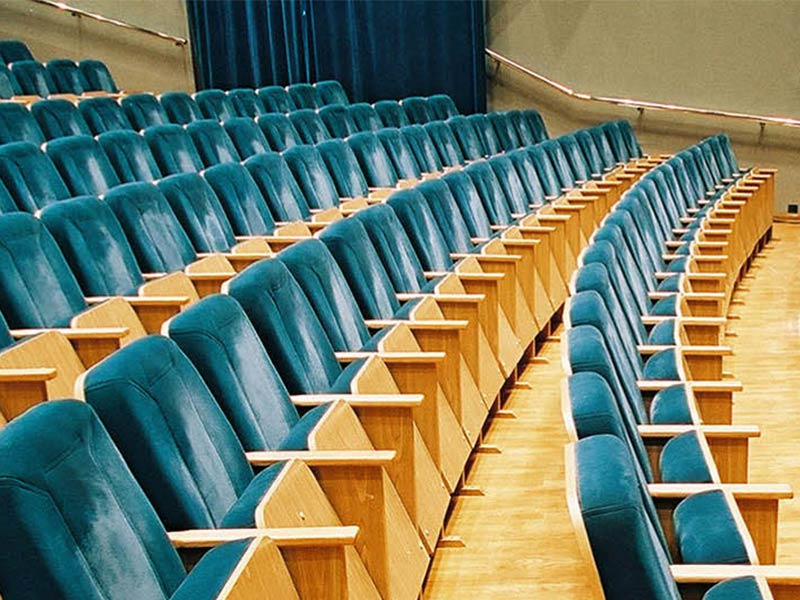
The client is a terminal factory in East Europe, specializing in auditorium chair production. The factory handles carbon steel tube cutting, splicing, and welding processes to meet demands from business growth. Due to expansion, the client required new equipment to improve cutting accuracy and welding quality, paving the way for future robotic automated laser welding.
Challenges and Goals
Pain Point 1: Tube cutting demands increasing with business volume; current plate-tube machine cannot meet future needs.
Pain Point 2: Current plate-tube machine has slow cutting speed and poor results.
Pain Point 3: Lack of bevel cutting, leading to poor splicing and lower welding yield.
Target Metrics: Introduction of laser tube cutter greatly enhances production cutting capacity and new design possibilities. With laser cutting, weld seam splicing quality improves significantly, allowing laser handheld welding for batch production to achieve better-looking welds. Paving the way for subsequent robotic automated welding.
SteviS Solution and Key Configurations
SteviS delivered the ST-TP120E bevel laser tube cutting machine and ST-HLW laser handheld welder, with key configurations addressing the pain points:
Tube Cutter: 120mm precision chuck (Selection Reason: Prevents dust entry into cylinder, extends machine life, addresses poor cutting results and frequent maintenance; supports 10mm10mm to 120mm*120mm tubes).
Tube Cutter: BOCHU FSCUT3000D-E professional bevel cutting system (Selection Reason: Covers most furniture manufacturing workpieces, supports bevel cutting to improve splicing and welding yield).
Tube Cutter: 3KW Raycus CE laser (Selection Reason: Provides stable power for carbon steel tubes, enhances speed and effect).
Tube Cutter: 90-degree cutting head with cast aluminum base (Selection Reason: Ensures faster, precise cutting and swinging for vertical cuts, holes, and bevels).
Handheld Welder: 3KW Raycus CE with global warranty (Selection Reason: Worry-free after-sales, for batch welding to enhance weld quality and appearance).
Handheld Welder: Metal welding gun, anti-fouling and durable, with Local language system (Selection Reason: Convenient operation, strong durability, suits factory environment in East Europe, improves welding efficiency). Automation modules include 6m automatic belt feeding rack (for bundle loading and uninterrupted production) and 2m servo unloading support (for precise small cuts). The solution complies with CE certification.
Delivery and Implementation Process
Order Date: August 2025.
FAT Date/Key Points: November 2025, FAT verified cutting precision, bevel function, welding performance, and system stability.
Shipping Date/Method: Late December 2025, sea freight.(as per customer request)
Arrival Date: Estimated January 2026.
Installation/Debugging Time: 2 weeks.
Training Targets and Content: For factory operators, covering machine operation, daily maintenance, and usage tips.
Acceptance Points: Cutting tests per client's drawings, including vertical cuts, holes, bevels, and welding verification.
Applicable Scenarios for Similar Factories
If your factory faces increasing tube cutting demands, slow speeds in existing equipment, or lack of bevel functions leading to low welding yields, assess your current carbon steel tube specs (e.g., 15mm*15mm1.5mm to 80mm*40mm2mm) and cycle times, and consider a bevel laser tube cutter with handheld welder to improve precision, weld quality, and consistency, paving the way for automation upgrades.
Próximos pasos
Optimize your production now! Submit your material specs, processing videos, capacity targets, or drawings via our website form for a customized solution and quote. Please contact us.
Antecedentes del cliente
The customer is a bridge steel fabrication plant in East Europe. Their production requires both standard tube cutting and heavy structural section processing. As project-type orders increased, outsourcing became expensive and less predictable due to logistics and subcontractor scheduling. The customer wanted to bring cutting in-house with a solution that could handle a very wide size range while supporting bevel cutting for welding preparation.
Challenges & Goals
High outsourcing cost: most structural profiles were processed by subcontractors.
Wide size range: from 40×40 mm square tube to 640×640 mm square sections, up to Ø650 mm round tube; bar length up to 12,100 mm and weight up to 3,000 kg.
Multiple processes required: straight cut-off, hole cutting, and bevel cutting for welding preparation.
Target direction: replace outsourcing with in-house processing, validated by cutting tests based on the customer’s drawings.
SteviS Solution & Key Configuration
1) 670×670 mm heavy-duty precision 3-chuck clamping: selected to cover both small tubes (40×40 mm) and large structural sections with stable holding.
2) BOCHU bevel cutting control (per contract BOM): chosen to enable bevel tool paths and control logic for welding preparation; BOCHU provides reference solutions for heavy tube/structural cutting with 3-chuck delivery and bevel capability.
3) 12 kW Raycus (CE) fiber laser: provides power margin for carbon steel cutting in heavy-duty applications (exact model and nameplate as per contract).
4) 12 m semi-automatic loading & unloading: aligned with 12,100 mm profile length to simplify handling of long and heavy materials.
5) Process coverage: cut-off + holes + bevel cutting on one machine, reducing inter-process transport and waiting.
Delivery & Implementation Timeline
Sep 2025 | PO placed: confirmed size range, maximum length/weight, and site layout constraints.
Mid-Jan 2026 | FAT (planned): cutting verification using representative parts/drawings, focusing on 40×40 mm cutting stability, bevel geometry, hole accuracy, and long-bar cutting consistency.
Mar 2026 | Arrival (estimated): positioning, utilities hookup (power/air/exhaust).
Commissioning | ~1 month: joint delivery by China-based engineers and local engineers in East Europe.
Training: operation, daily maintenance, and practical tips (including key inspection points and consumables).
Acceptance: cutting tests strictly based on the customer’s drawings.
Results & Benefits (Stage-Based; Before/After)
Note: This case is currently at the “PO placed, FAT/installation pending” stage. The following items define the target outcomes and acceptance logic; final results will be confirmed after FAT, on-site acceptance, and the first month of production.
Make-or-buy shift: from outsourcing structural cutting to primarily in-house laser cutting, reducing dependency on subcontractor capacity.
One-machine coverage: from separate solutions for tubes vs. structural sections to one integrated machine covering the required range.
Process consolidation: from distributed operations to cut-off + holes + bevel on one platform.
Lead-time control: from subcontractor scheduling risk to in-house planning control.
Before / After Table (Target Comparison)
Artículo
Before
After (Target)
Structural cutting
Mostly outsourced (high cost)
Mostly in-house with tube laser
Size coverage
Multiple paths / subcontractors
40×40 to 640×640, up to Ø650
Processes
Split across steps
Cut-off + holes + bevel on one machine
Scheduling
Dependent on subcontractors
More controllable internal planning
Applicable Scenarios for Similar Factories
Bridge steel / structural steel fabricators needing both tube and large profile cutting on one platform.
Plants with high outsourcing costs and unpredictable subcontractor schedules.
Projects requiring bevel preparation for welding and consistent cutting quality across long/heavy materials.
Next Step
Send us your material grade & thickness range, min/max section sizes, 3–5 representative drawings (PDF/DXF), target monthly output, and your available shop-floor length/handling method.SteviS will provide a selection proposal, clamping & loading concept, cycle-time estimate, quotation, and delivery plan.
Antecedentes del cliente
The client is a terminal factory in Long Beach, US, specializing in metal processing. The factory handles galvanized iron and carbon steel coil uncoiling, leveling, and shearing processes for production needs. Due to business expansion, the client needed a new line to cover a wider thickness range in material processing.
Challenges and Goals
Pain Point 1: Current production lacks uncoiling, leveling, and stacking capabilities.
Pain Point 2: Coil thickness range is wide, from 1.0mm to 6.5mm, hard to find compatible shearing lines in the industry.
Target Metrics: Introduction of uncoiling leveling shearing line helps client expand business areas.
SteviS Solution and Key Configurations
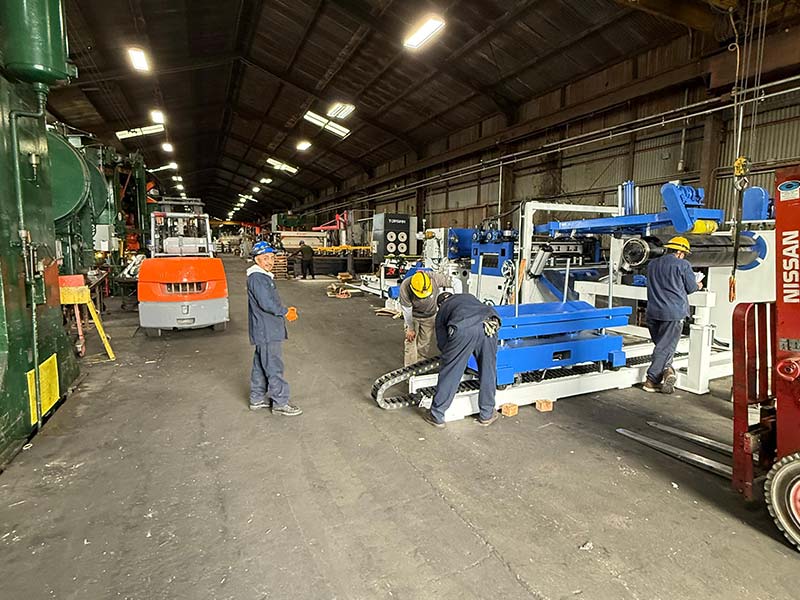
SteviS delivered the ST-PL2000 uncoiling leveling shearing line, with key configurations addressing the pain points:
Automatic Decoil Machine:
Material width 200-2000mm, inner diameter Min ø430mm to Max 530mm, outer diameter ø1500mm, max load 10T, hydraulic expansion, 7.5KW motor, chain drive, frequency converter speed regulation, loading trolley, pressing arm, gantry support (Selection Reason: Compatible with wide thickness coils, addresses lack of uncoiling, ensures stable loading).
Conveyor: Loadable width <2000mm, belt weight 30Kg, 1.5KW reducer, frequency converter speed regulation, 2mm PVC oil-resistant belt, total length 3000mm (Selection Reason: Ensures smooth post-shearing conveyance, supports auto stacking flow).
Material Stacking Machine: Max width 200-2000mm, length 500-3000mm, stacking height 20-450mm, pneumatic patting, 3T hydraulic lift, hydraulic roller discharge (Selection Reason: Enables auto stacking, solves lack of stacking capability, improves collection efficiency). Automation modules include auto uncoiling and press arm on the rack (for thick material entry into leveling), servo auto feeding, fixed-length cutting, and auto plate collecting. The solution complies with CE certification.
Delivery and Implementation Process
Order Date: September 2025.
FAT Date/Key Points: December 2025, FAT verified uncoiling, leveling, shearing accuracy, and overall stability.
Shipping Date/Method: End of December 2025, sea freight.
Arrival Date: Estimated February 2026.
Installation/Debugging Time: 1 week.
Training Targets and Content: For factory operators, covering machine operation, daily maintenance, and usage tips.
Acceptance Points: Cutting tests per client's drawings, including 1.0-6.5mm thickness compatibility and accuracy verification.
Resultados y beneficios
Project expected to yield interim results after February 2026
Applicable Scenarios for Similar Factories
If your factory lacks uncoiling, leveling, stacking capabilities, or faces wide coil thickness spans (1.0-6.5mm), assess current material specs (e.g., inner diameter Φ450-Φ530mm, outer diameter Φ1500mm, width ≤2000mm) and needs, and consider an uncoiling leveling shearing line to expand business areas and efficiency.
Next Steps (CTA)
Expand your production now! Submit your material specs, processing videos, capacity targets, or drawings via our website form for a customized solution and quote. Please contact us.
Background: A Long-Term Partnership Built on Performance
One of our key customers in Mexico, a stainless-steel tube manufacturer, originally purchased SteviS laser tube cutting machines through a local distributor. Since installation, the machines have been running smoothly and consistently, delivering stable performance every day.
The introduction of laser tube cutting significantly improved both the cutting output and the overall quality of their products. However, the downstream processes—such as welding and polishing—were still handled manually using traditional TIG welding. As cutting speed increased, these manual steps became a bottleneck. Large volumes of semi-finished products started piling up, creating delays and reducing overall production efficiency.
The Challenge: Skilled Labor Available, But Not Sustainable
Although the customer’s city has no shortage of highly skilled welders, maintaining a long-term team of experienced welders became an increasingly heavy financial burden. The imbalance between fast, automated cutting and slow, manual post-processing pushed the company to seek a solution that would increase capacity without significantly raising labor costs.
The Decision: Adopting Robotic Laser Welding
To solve this challenge, the customer decided to introduce new technology—robotic laser welding. Before confirming the purchase, they sent us samples for welding trials. We performed full welding tests and quality inspections, and as always, the customer was very satisfied with the results.
Implementation: Fast Installation, Smooth Training, Immediate Productivity
Once the machine arrived in Mexico, our SteviS after-sales engineer traveled to the customer’s factory to provide on-site installation, calibration, and operator training. With the engineer’s guidance, the customer’s technical staff quickly mastered the system and began running production confidently.
Looking Ahead: Custom Polishing Solutions to Complete the Automation Line
This upgrade has already helped the customer greatly increase productivity and stabilize product quality. In the next phase, SteviS will provide a customized polishing solution, helping the customer further automate their production line and achieve even higher efficiency.
We recently worked with a practical business owner from the Netherlands who runs a door and window fabrication shop. Like many manufacturers, he faced two key challenges: finding skilled welders was difficult, and meeting strict European safety standards was a must.
He found one of our 2KW platform laser welding videos on our YouTube Channel and saw a potential solution. What happened next was straightforward and efficient.
He contacted us and confirm order, just within 1 week!
Here’s how it worked:
The Goal: He needed a system that could improve welding consistency and ensure operator safety.
The Solution:We proposed our standard 2KW platform laser welder, but the real value came from customization. We designed a custom safety enclosure to meet EU regulations and created specialized fixtures to hold his specific window and door profiles.
The Result:The system is now on its way to him. It will allow his existing staff to load a part, start the automated weld cycle with confidence, and focus on other tasks. This reduces reliance on highly-skilled manual welders and ensures complete safety compliance.
The entire process was built on clear communication.
When he asked about the custom enclosure, our engineering team provided a design within a short timeframe. There was no sales fluff - just practical answers to practical questions.
If your business faces similar challenges with skilled labor or safety standards, let's talk. We specialize in providing reliable, customized welding solutions that just work.Reach out today to see how we can help solve your specific production needs.
Tired of inconsistent welds, rising labor costs, and the constant hunt for skilled welders? You know the drill – the sparks, the heat, the bottlenecks. What if you could achieve perfect seams, every single time, while boosting productivity and safety?
That's exactly what customers in Bosnia and Herzegovina envisioned. As a leading provider of metal processing equipment, serving both large-scale and medium production, they knew their manual welding processes were holding them back. Seeking a smarter solution, they found us from our official website.
They are not just looking for a robot; they need a strategic partner. Through detailed discussions, multi meetings, we deep into their specific challenges, production lines, and goals. We didn't offer a one-size-fits-all solution; we crafted a winning strategy.
Finally we offer them one set industrial Robot and one Cobot.
Industrial Robot:Taking over high-volume, repetitive welding tasks with unmatched speed and unwavering consistency.
Cobot:Working safely alongside human operators for intricate welds or smaller batches, enhancing flexibility.
For our customer, this meant:
Flawless Quality:Say goodbye to inconsistencies and rework.
Skyrocketing Output:Robots work tirelessly, significantly boosting throughput.
Costs Under Control:Reduce reliance on scarce skilled labor and minimize waste.
A Safer Shop Floor: Removing operators from hazardous welding fumes and sparks.
Future-Proofing: Gaining the agility to adapt to changing demands. Whether you're tackling massive production runs or intricate custom pieces, we have the robotic expertise and collaborative approach to transform your welding operations. We listen, we strategize, and we deliver solutions that work seamlessly for your unique factory floor.



 Español
 English
 Български
 Русский
 Türkçe
 Português do Brasil
 Português
 Polski
 Italiano
 Română
 Српски језик
 Slovenščina
 Magyar